Beats Rhymes & Life: The Travels of A Tribe Called Quest (2011)
 VERDICT:
8/10 Native Tongues
Who knew Michael Rapaport had it in him?
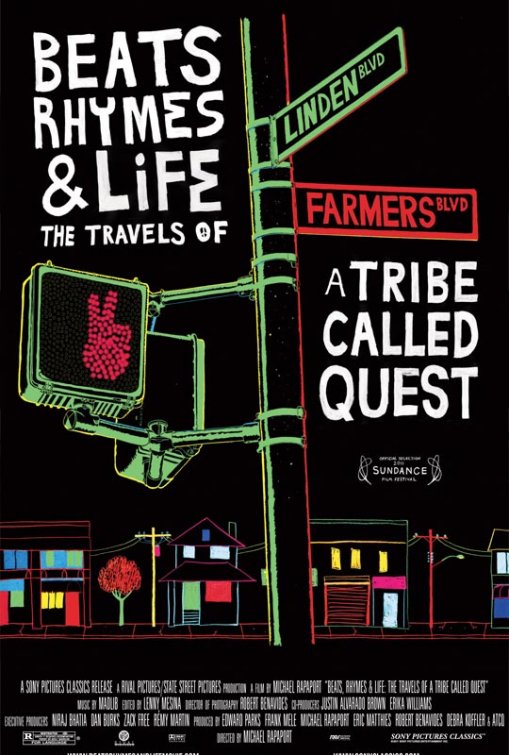
Beats Rhymes & Life is a documentary about A Tribe Called Quest. For those unfamiliar, A Tribe Called Quest is a hip-hop group that blew up in the late ’80s/early ’90s, released five albums over the course of eight years – three of which are generally considered gamechangers – and then broke up in 1998. Nearly a decade later, they reunited, started going on tour, and continued to tease fans with a long-awaited sixth album that has yet to see the light of day.
If you’re not into hip-hop, I won’t be throwing the first stone, but if you’re even in the least bit interested, A Tribe Called Quest is a damn good place to get acquainted. See, once upon a time I was just like you, a high school freshman at a new school in the Bronx with a jones for rock and a bitter hate for rap songs that weren’t called “Gettin’ Jiggy Wit It.” But as I quickly learned, it’s hard to escape hip-hop when you go to school in the Bronx, and if you don’t like it, then you’re in the minority. Luckily, it started to grow on me instead of leading to my total alienation from the school cafeteria, and by the time I was sophomore, I was battling kids like B. Rabbit, yo.

Alright, maybe not, but you get the idea. I don’t remember what the tipping point was or what hip-hop album first found its way into my trusty Discman, but People’s Instinctive Travels and the Paths of Rhythm, the debut album by A Tribe Called Quest, was an early revelation. When I listen to it today, I can’t help but roll my eyes at how many times Q-Tip, Phife, and Jarobi use their names to string lyrics together and how the deepest song is about Q-Tip losing his wallet in El Segundo, but it’s still fun, it’s still catchy, and the samples are still cool as hell. If you haven’t heard ’em, the easiest, crudest way to describe A Tribe Called Quest is that they’re a jazz/hip-hop fusion. Don’t quote me on that, but I think it’s pretty accurate complement.
So being a fan and getting to see a movie like this that allows me to rediscover a band that I already love and from an angle that I’ve never seen before, that’s something special. What’s even better is that first-time director Michael Rapaport is telling their story from the same set of shoes and it comes across not only in his interactions with the group, but in the testimonials he gets out of them. I for one never really knew why ATCQ broke up, and while part of what makes their reunion interesting is hearing their sides of the story, it’s seeing how raw their wounds are that really drives it all home.
It’s no big surprise that even the greatest of bands come and go, but Q-Tip, Phife, Jarobi, and Ali are the closest thing you can get to family without blood coming into the picture. It’s a connection that brought them together as kids, it’s a connection that gave them their jump-off, it’s a connection that tore them apart, and it’s a connection that keeps bringing them back despite everything that’s gone down in the past. It goes without saying that music is a huge part of this movie and a huge part of the group, but it’s that family dynamic and the honesty that comes out of these four guys that really elevates this from being a 90-minute episode of Behind the Music.

As you’ve probably gathered, I found a lot to enjoy from this movie and I’ve been listening to ATQC like gangbusters ever since. Though even for someone who just found out they exist, I’d be pretty surprised if an appreciation wasn’t to be gained for what they do, what they did, and why music needs groups like A Tribe Called Quest. I could go on about it ’til my brain gives out, but hip-hop these days tends to be a sad state of affairs. There have always been exceptions to the rule and there always will be, but back in the late ’80s/early ’90s, the hip-hop game was different – from the beats, to the rhymes, to the life. Artists used to actually put effort and creativity into the beats they laid down, their words used to mean something even if it was as extreme as “fuck the police,” and the life was more about a movement, a message. Today, it feels like a status symbol that can be achieved with the absolute minimum amount of effort and talent, and on the rare occasion that I do listen to the radio, it sucks to keep hearing the clicks and whistles.
Honestly, you remember how big that “Superman that ho!” song by Soulja Boy was a couple years ago? That’s the shit I’m talking about, folks, and that shit was no fluke either. Not trying to make any rash generalizations, but serenity now…

The point is, A Tribe Called Quest is a group that stands for everything that was once great, and continues to be, about hip-hop. Unless I’m mistaken, I don’t think there are a whole lot of documentaries about hip-hop acts. Granted, hip-hop doesn’t exactly have the same kind of lengthy history as blues, jazz, or rock and roll, but it’s a damn shame nonetheless because it’s music that can get written off pretty unfairly and music that deserves just as much respect and attention as the rest of ’em. I feel like a lot of people throw the word “innovators” out when talking about legends in the music industry, especially in the world of hip-hop, but the description truly fits for A Tribe Called Quest.
Word on the street is that Q-Tip hasn’t been the biggest fan of this movie, but Beats Rhymes & Life is nevertheless a fantastic introduction to a group that deserves to be heard. Coming from the viewpoint of someone who’s already on the bandwagon, it really was something to see the group from such a genuine, behind-the-scenes perspective, and hat’s off to Rapaport for all the flow, style, and love he made this with. There are a bunch of great moments here, moments that gave me goosebumps because the music is just that good and the passion behind it is just that palpable, and even if the subject matter isn’t perking your interest, give it a shot, it may just surprise you.
Better yet, do yourself a favor. Go listen to The Low End Theory and Midnight Marauders. That’s what’s up.
Martha Marcy May Marlene (2011)
 VERDICT:
6/10 Jonestowns
No, seriously, don’t drink the Kool-Aid.
Martha Marcy May Marlene is about a girl who goes to live with her estranged sister after escaping from a backwoods cult of sorts in the Catskills. As she tries to readjust to a life of relative normalcy, the girl begins reliving the highs and lows that highlighted the last two years of her life and changed her in ways she can’t seem to shake. It doesn’t take long for her sister to realize how truly messed up her little sis is, and as the memories get worse, so does their already-strained relationship.
The only things I knew to expect from this movie were a stellar performance from an Olsen sister who no one knew existed, and a title that everyone in the world was going to mix up every time they said it. The good news is that Elizabeth Olsen doesn’t disappoint and I’m not mumbling the words after “Martha” any more, but the bad news is that I’m still not sure about everything else.

If I could do it all over again and see this movie for the first time, I’d watch it with the mindset of someone going into a horror movie rather than a drama or thriller. Aside from the technicals and the acting, the most lasting aspect of this movie was how totally upsetting it was. Not upsetting in the sense that I was disappointed, but upsetting in terms of tone, context, and the universal truth that cults are fucked up. Ultimately, this movie seems to be about two things: how easily people can be preyed upon and how weak-minded and -willed some people can be. I recently read a blurb stating how this movie’s about facing your fears, but I think that’s a bunch of bullshit. If the desired effect from writer/director Sean Durkin was to leave me unsettled and feeling like a good long shower was in order, then he succeeded with flying colors. But even so, there needs to be something more.
Maybe it’s a matter of preference, but I have trouble seeing the point in a movie about a vulnerable girl being manipulated to where she can’t mentally escape from her past even after physically escaping from it. Now, if you look at it from a horror standpoint, that premise could go a long way. But since that wasn’t the angle I was watching from, I ended up leaving the theater two hours later wondering, “What was I supposed to gain from that?” If there had been more development among Olsen’s character, Martha, her sister, and her sister’s husband instead of them trying to get crazy Martha to open up, then getting frustrated because Martha won’t tell them anything, then doing it over and over again until everyone’s just fed up with the whole situation, perhaps there’d be more to be gained.
But as is, it just feels repetitive, like Durkin didn’t know where to take the plot after Martha flew the coop and settled on a fistful of awkward silences peppered with some melodramatic screaming matches. And, folks, that’s no place to settle. Wasn’t sure how this was all going to wrap up either, and when it finally did, it was mighty ambiguous. Not that I need my movies to finish with a bow on top and the ambiguity wasn’t really an issue until a majority of the theater echoed “What?” when the screen went black, but this was one instance where I could have gone for some sense of finality.
Then again, Durkin sure has a way with the camera. I loved how dark, faded and naturally ominous everything looked, I loved all the match cuts he used to transition the plot from Martha’s past to her present, and I loved the mood he created with such a subtle hand. Pretty impressive how truly seedy you can make a person look simply by emphasizing the clothes that don’t fit them. For a script that felt like it was running in circles, it helps that Durkin direction and his cast can pick up the slack.
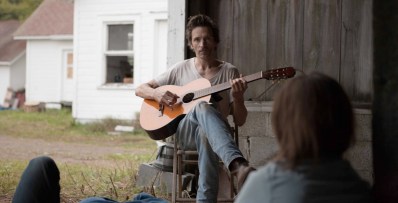
And getting back to Elizabeth Olsen who’s doing the family name some serious favors since Mary-Kate started sucking face with Ben Kingsley. For such a tortured role, let alone a debut role, she totally commands the screen and brings a good deal of complexity to a character who seems to have a lot going on upstairs. She’s no joke, I don’t know if she’s got Oscar written all over her anything, but she can totally carry a movie. And backing her up is John Hawkes doing the whole Teardrop thing while being creepy as all hell as the cult leader who totally effs up Martha’s being.

It’s fun to write about movies I hate, it’s fun to write about movies I love, but it’s the ones that leave me feeling borderline indifferent despite their accomplishments that I always have the most trouble with. Martha Marcy May Marlene is what happens when Big Love meets Dogtooth, and while it absolutely excels in terms of acting and film making, I wish I could say the same about the story and script. I won’t call it disappointing because my expectations weren’t that high to begin with and I really did like the things it did well, it just kinda sucks to watch a movie for two hours and then wonder why you just spent two hours watching it?
The one thing I will say out of all these conclusions I’ve drawn is that while this is an ambiguous movie, arguably to a fault, it’s also a movie that one can potentially draw a lot of meaning out of it or sit there with a big question mark on their face at the end credits. I appreciate that about it, I just happened to be in the latter category, and I don’t consider my Verdict up there the final say in the slightest. This thing is definitely different in the way it tells its story and the story it’s trying to tell, and while that’s very much something to applaud, it just didn’t come together for me as well as it could have.
Moneyball (2011)
 VERDICT:
9/10 Pickin’ Machines
It’s hard not to be romantic about baseball.
Moneyball is based on the true story of one Billy Beane, a former ballplayer who couldn’t cut it in the big leagues, took a job as a scout, and ultimately landed himself a gig as the General Manager of the Oakland A’s, one of the poorest teams in baseball in terms of bank roll and wins. After coming to the realization that he didn’t have the financial resources to compete with big-budget teams like the Yankees and Red Sox, he decided to scrap the old way of building a team by drafting the best body or swing, and instead recruited players by their stats. Though written off by many at the start of the ’02 season as having lost his mind, Billy and his crack squad of Sabermetricians took a team of nobodies that nobody wanted and ended up changing the game entirely.
It should be pretty obvious at this point that I watch a whole lot of movies in my free time. It’s crazy, it’s probably why my eyes are so damn dry all the time, but when I’m not tethered to Netflix or overdrafting my bank account to fund the New York City theater conglomerate, I’m reading my ass off. It’s cheaper, it helps me zone out the ten people blaring dubstep through their headphones on the subway commute each day, and every once in a while I come across a book that reminds me why I love books. Moneyball by Michael Lewis is one of those books, one that may very well be in my Top Ten. That’s coming from someone who thinks watching a regular-season baseball game on TV is the most excruciatingly boring thing in the world next to solitary confinement. With that being said, good lord, was I skeptical about this movie.
As incredible as Moneyball is as a book, it’s not exactly tailor-made for the big screen. It’s like Freakonomics mixed with The Natural, only most of the action happens in the clubhouse than on the field. That’s not to say that the book isn’t riddled with one unforgettable underdog story after another that made me want to high-ten the nearest train conductor, but so much of it really is about the stats which – though endlessly fascinating in text – might not get the audience cheering for more. In addition, so much of what made the book great is Michael Lewis’ writing, and translating an author’s voice to film is always a near-impossible task.
But that’s what great about the way everyone involved approached this movie. There seems to be this clear love for the book, a love for the game, and a general understanding that in order for this to work, they have to make it their own while staying true to the source material. From the actors, to the writers, to the director, everyone is on board with this plan from start to finish and that’s really why it works as well as it does.
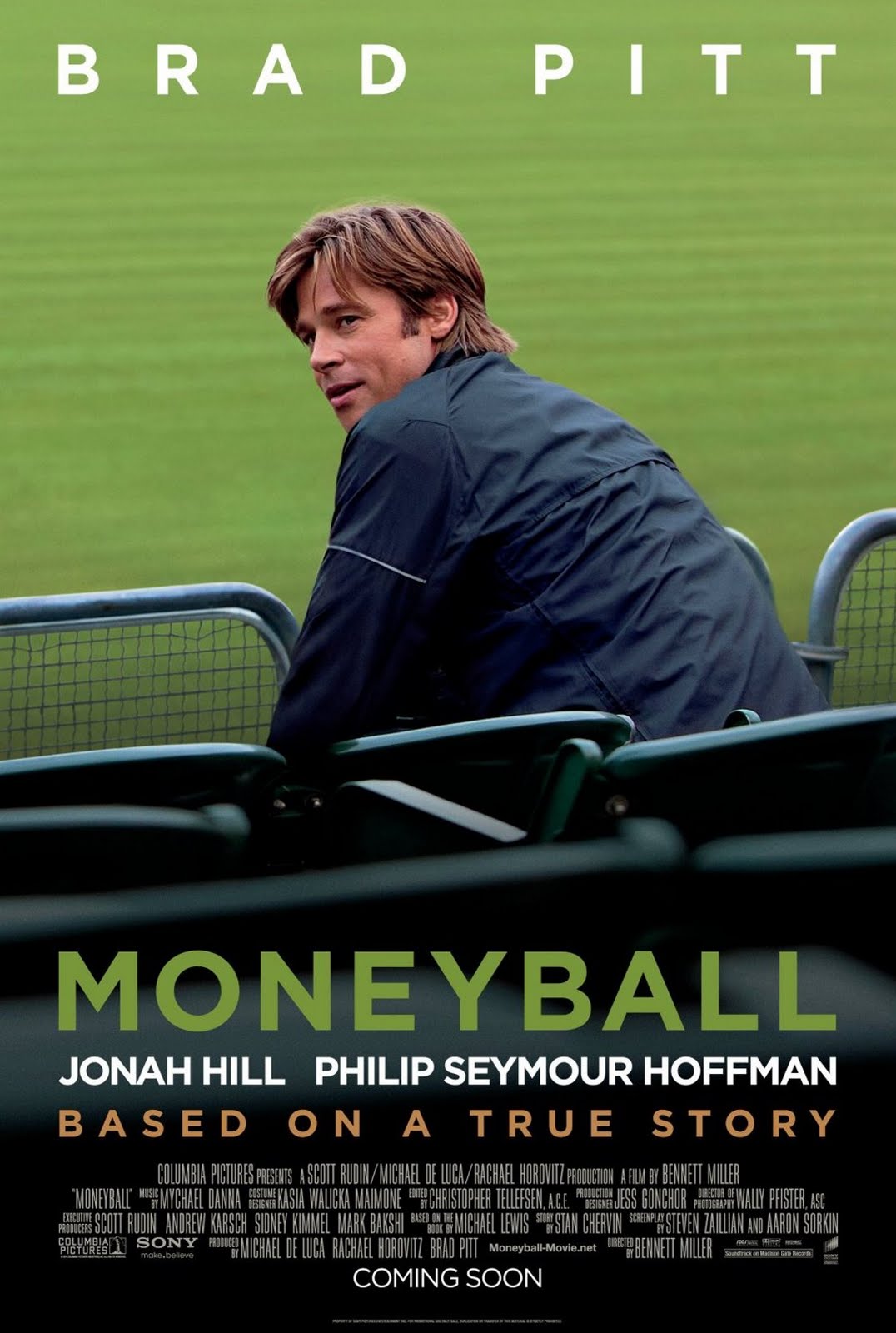
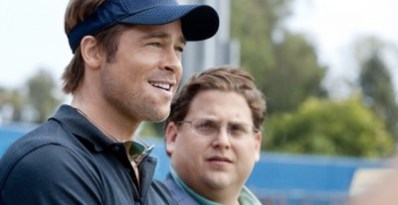
Aside from the performances, the thing I love about this cast is that they’re as unlikely as the characters they’re playing. Brad Pitt, “Sexiest Man Alive” 23 years straight, playing the eclectic, unglamorous general manager of a baseball team that no one but Oaklanders really care about. Jonah Hill, best friend to McLovin, playing it straight in a suit and tie as Peter Brand, the brains behind the new clubhouse. Chris Pratt, the resident endearing bonehead of Pawnee’s Parks & Recreation Department and an actor who a lot of people are unfamiliar with, playing Scott Hatteberg, the beefed-up, down-and-out hero of our story behind the plate. And then there’s Phillip Seymour Hoffman, and he’s actually perfect as Art Howe, the team’s curmudgeonly manager who refuses to go along with Billy’s schemes. Not to say that everyone else isn’t perfect in the respective roles, but it’s a motley crew alright and it’s just what the doctor ordered.

And as far as all the Oscar buzz around Brad Pitt is concerned, I can see it and I would nod in approval if he took home the gold come February. Ever since Inglorious Basterds, my opinion of Pitt has changed drastically from that of “pretty boy” to “where it’s at.” It’s always something to see an A-lister who doesn’t buy into the global opinion of him and opts to take edgy, off-beat roles rather than the fattest paycheck. Not sure why it took me ’til Aldo Raine to come to this realization, but he’s still killing it as usual. Then again, the supporting cast here is every bit as good as he is and it’s hard to give Pitt all the credit when the story is as much about Beane as it is about everyone around him.
Nor does it hurt that they were given one hell of a script to work with thanks to Steven Zaillian and Aaron Sorkin. Since Sorkin’s behind it, it’s wordy as hell, but it works because Sorkin’s one of the few writers out there who can make the alphabet song read like a State of the Union address, and with all the information that’s jammed into the book, it needed a wordy screenwriter to do it justice. It’s really a trip the way he and Zaillian capture the language of the bullpen and pay tribute to Lewis without trying to mimic him, and right from the get-go, I was all-effing-ears. But like I said, this is a team effort among everyone involved and the cast does a phenomenal job of downplaying their lines, keeping a level head when tempers are rising, and acting naturally instead of seeing who can yell louder. For a sport where screaming matches and temper tantrums are a pretty common occurrence, it’s nice to see a more calm and collected approach that makes the occasional loose cannon sound like an atom bomb.
In short, it’s a glowing example of how you adapt a great novel into a great movie by making it your own and not following the source material verbatim. Still wish Sorkin had left in the draft where Beane picked up Hatteberg, Chad Bradford, and David Justice rather than just skip to spring training, but a minor complaint all the same and a nonexistent one for anyone walking in blind. Also love how much focus they lent to Hatteberg’s story, because Scott Hatteberg is the freakin’ man.

Director Bennett Miller also makes this thing look beyond gorgeous and in turn adds a real sense of beauty to the game that’s rare to come by in a genre that tends to focus on the dirt, the dip, and the dudes. For a movie that could easily be categorized as a talking heads drama, a Ken Burns documentary, and a good old fashioned sports movie, it’s incredibly impressive how he balances each and fuses them together seamlessly. Makes me wonder why he only has two movies to his credit, but whatever the reason, I am dying to see more.
I know this next statement may come across as blasphemy to some, but this is one of the best baseball movies I’ve ever seen. It’s no Field of Dreams, but in a business where people get to make sports movies each year that are carbon copies of the same sports movie that’s been coming out since Rocky, it’s incredibly refreshing on so many levels to see something different that also pays off as something truly inspirational and familiar. That was the beauty of Moneyball as a book, and though that could have been the reason this movie crashed and burned, the way everyone involved came together to prevent that from happening is just one of the many reasons it managed to set a bar that sports movies rarely ever get close to reaching.
So if you haven’t read the book, READ THE BOOK, but if that ain’t gonna happen, go see Moneyball anyway and enjoy what is far and away one of the best movies I’ve seen all year and may be the only movie that pulls a Social Network by excelling on every single front. Had me smiling the whole way through, had me feeling romantic about the game all over again, and that’s about all a former little league pitcher-turned-movie nut can ask for.
And the best horror remake is…
 JOHN CARPENTER’S THE THING!!!
As much as I love The Fly, this one was a no-brainer. Anyone out there see the “prequel” yet? More importantly, how outrageously disappointing/unnecessary was it?
Swell voting, yo.
RESULTS:
– The Thing (’82): 9 votes
– The Ring: 6 votes (still scares the crap out of me, still haven’t seen Ringu)
– Dawn of the Dead (’04): 5 votes
– Let Me In: 2 votes
– The Fly: 2 votes
– Funny Games: 2 votes
– The Blob (’88): 0 votes (let me tell ya’, there are some awesome kills in that remake)
Red State (2011)
 VERDICT:
5/10 Demon Days
You can take Silent Bob out of Jersey…
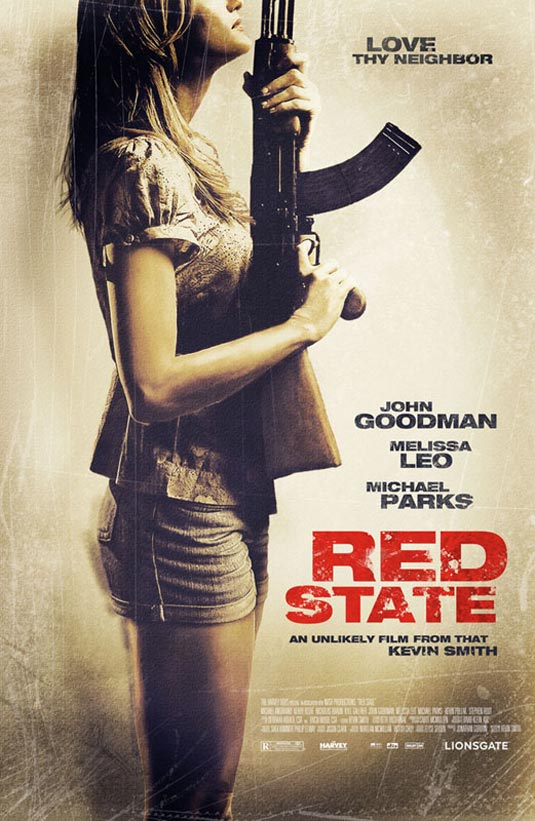
Red State is about three horny teenage boys who are lookin’ to have themselves a foursome. Given that you can find just about anything on the internet these days, they find a lonely lady online who just so happens to be looking for three young studs to give her the business, and so they drive up to her trailer in the back country to oblige her in ways only three horny teenagers can. Lo and behold, they get roofied before their flies are undone, they pass out on top of each other, and wake up soon after to find themselves hostages of a homicidal version of the Westboro Baptist Church. With their buzzes and libidos officially killed, the teens abandon their search for a devil’s foursome and try to find a way out before getting strapped to a crucifix and shot in the brain for Jesus.
As someone who watches a lot of horror movies and is continually saddened by all the unoriginal imitators and endless cheap scares I have to sift through each year because pickin’s are always slim, I was fa-reakin’ excited by the prospect of Red State. Folks, few things in this crazy world are more deeply horrifying and royally fucked up than the charming folks at the Westboro Baptist Church. The thing about exorcisms, vampires, zombies, and ghosts is that they’re all scary in their own right, but I don’t think anyone walked out of Paranormal Activity 3 last weekend and thought, “Shit, I hope that doesn’t happen to me.” Fred Phelps, on the other hand, has been happening, is continuing to happen, and there are people who treat him like a messiah.

That is scary stuff, and that’s why this is an absolutely brilliant idea and an absolutely brilliant title for a horror movie. Additionally, it was a smart move by Smith to label this killer cult the Five Points Church rather than focus the story on the Phelps crew by name, thereby depriving them of press they don’t deserve. Believe you me, those lunatics just love their press.
But let’s talk about Kevin Smith. If you went into this blind and happened to miss the opening credits, you’d be flat-out flabbergasted when his name showed up at the end. Not to sell him short or anything, but Smith is a pretty niche director. If his name’s attached, it’s probably set in Jersey, it’s probably a comedy, it’s probably crude as all hell, and it probably features a lot of the same people who were in the last Kevin Smith movie you saw. For the most part, I like Kevin Smith movies, and all those niche qualities of his as a film maker are the very reasons he’s a household name. But this is something else entirely for Smith…at least as a director.
It’s set in Middle America, it’s billed as a horror movie, and there’s not the slightest trace of Ben Affleck, Jason Mewes, or Jason Lee in sight. Awfully curious as to what spurred this complete 180 of a career move, but for a guy whose only real action credit to date is Cop Out, he deserves a whole lot of credit for what he does behind the camera. From a visual standpoint, this sucker is gritty, it’s constantly in-your-face, it’s intense and then some at points, and an inordinate amount of people get shot up by the time it’s all over. Unless IMDB is screwin’ with me, I don’t think that happens in a lot of Kevin Smith movies and it’s great to see him excel at something completely out of his comfort zone.

On top of that, he’s a got a solid cast to work with featuring some really big names and some smaller ones that I’d like to see more of. The star of the show is easily Michael Parks as the madman behind the Five Points Church, Abin Cooper, but John Goodman and Melissa Leo hold their own as usual.
So we’ve established that it doesn’t look like a Kevin Smith movie, but then there’s the script, and it totally sounds like a Kevin Smith movie. Now, of every script Smith has written, there are only two that stand head and shoulders above the rest: Chasing Amy and Dogma. The reason those two stood out for me is that they dug a lot deeper than most Smith scripts in terms of what they was trying to say, and as a result, it made the ridiculously raunchy humor seem that much more tolerable, even enjoyable. When I think of Clerks, all I think about is “snowballing” and how I’ll never get the appeal to that movie no matter how many times I see it. I know I’m in the minority on this one, but that shit is gross, it’s just not my thing, and that’s always been a point of contention with Smith’s movies.
Now, Red State does have some relatively poignant things to say about people like Fred Phelps and how they rank among the rest of us. But unfortunately, it rambles like a bastard whenever it tries to make those points and it’s hard to take it all seriously when everyone’s still making more guttermouthed jokes than ever. In one sense, I get it, dialogue is what Kevin Smith does and that’s to be expected. In another, I hate long-winded speeches and referring to someone’s junk as being the size of a “Coke can.” Whether it be in real life or make believe, listening to someone go on and on and on and on and on about the same goddamn thing just to get to a point they started on about ten minutes ago is on par with Chinese water torture. There’s a lot of that here, and while some of it’s good and I understand why it’s there, it overstays its welcome pretty early on and doesn’t get any easier on the ears.
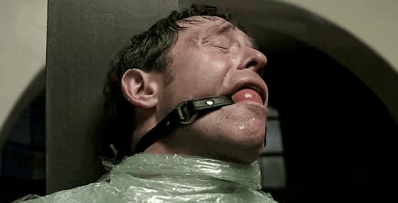
And for something that’s been heavily touted as a horror movie, it’s pretty surprising how little horror there actually is. In its defense, this is not your typical horror movie and how you’ll feel about this aspect in the long run has a lot to do with what you think a horror movie is in the first place, but for me, it was more an action movie with horror roots than anything else. Like I said, there’s an inordinate amount of shooting to be had and just not enough horror or scares to back it all up. Oh, how I wish it had been the other way around.
So Red State‘s not much of a horror movie and it’s still way more of a Kevin Smith movie than you’d expect, but there really is something to be said for its phenomenal premise and surprisingly boss direction. Maybe if Smith had taken the plot in a different direction rather than stage an all-out warzone, maybe if he’d gone with a different ending, maybe if I was bigger fan of Smith’s sense of humor, this could have been a revelation instead of a minor disappointment. I’d love to see him do more stuff along these lines, but the more I think about this, the more I think Smith should have written himself out.
The Good, The Bad, The Weird (2010)
 VERDICT:
9/10 Kimchi Westerns
If Sergio Leone and Indiana Jones went to Asia, overdosed on speed, and made a movie…
The Good, The Bad, The Weird is about a notorious killer who gets hired by a mob boss to hijack a train and steal a map from a government official on board. As fate would have it, a small-time crook shows up on the train first, mugs the said government official blind, and takes the map with him, clueless as to its value. And wouldn’t you know it, a bounty hunter shows up on the scene with guns blazing and a mind to collect the big fat reward on both of their heads. Before long, the lowly crook wises up to the importance of his “treasure map” when everyone in Manchuria starts chasing him down, and so begins a mad chase across the country to see who can reach the mother lode first.
As you’ve probably guessed, it’s very much an homage to The Good, The Bad and the Ugly, but by the same token, this is something else and then some.
So my history with writer/director Kim Jee-woon started ages ago when my friend Paul told me to watch A Bittersweet Life. Godknowshowlong later, I still haven’t given it a shot, but the moment I started realizing what an ass I’d been for dropping the ball was when I saw Jee-woon’s I Saw the Devil a few months back. Since I’m still thinking about how good that movie was and how something so straight-up evil could be so brilliant, I put this movie on my Netflix Instant queue and let it collect dust for another few months. Then, in a moment of clarity, I finally decided to give it a shot, and once again, I realized what an ass I’d been.

Folks, I really freaking liked this movie.
I remember going to see Casino Royale with my uncle when it was still in theaters way back when, and while I still think that’s arguably the best Bond movie of all-time, my uncle upped the stakes and immediately gave it a spot on his All-Time Top Ten without thinking twice. His reasoning? It had action, humor, and wow factor to spare, it was over before you knew it, and all he wanted was to see it again. In essence, it had everything you could ask for when you go to see a movie. I didn’t argue the point, but I never quite got that same sensation until now. It’s not in my Top Ten or anything, but sitting through The Good, The Bad, The Weird‘s non-stop, hi-octane, good-old-fashioned-but-brand-spankin’-new whirlwind of a rodeo for two hours and change might have been the best time I’ve had with a movie since Scott Pilgrim vs. the World entered into my life.
The story is simple. A badass cowboy, a crazy bandit, and a ruthless assassin hunt each other down and occasionally work together to settle old scores and shoot their way to the finish line with an unlimited supply of ammo and a serious lucky streak when it comes to dodging bullets. No, the premise isn’t the only thing this movie has in common with Leone, but by the same token, this is something all its own.

The first thing that really sets it apart is Jee-woon as both writer and director. Right from the opening train heist that barrels along at maximum velocity and wraps up 15 minutes later with your face glued to the screen and your grin stretched to your ear drums, you’ll know that this baby’s cooking with gas and fumes ain’t runnin’ dry. It’s stunning from a technical standpoint as Jee-woon keeps throwing in the craziest of shots in the craziest of scenes, it’s stunning from a visual standpoint even when it’s just watching a guy ride his horse across the Manchurian desert at sunset, and it’s insane how it never, ever lets up and continually manages to put a fresh spin on each new scene that you think you’ve seen before. I’m usually not a big fan of movies that try to keep things interesting by one-upping itself from one scene to the next because those movies tend to crash and burn, but this is very much an exception to the rule. By the time the Japanese army starts hunting these guys down and the body count reaches the triple digits in the blink of an eye, you’ll know what I mean.
And then there’s the script, and the script is as totally hilarious as it is flat-out enthralling. Well, it’s probably more fair to say that the script is really funny and it’s Song Kang-ho who makes it hilarious. Ever since I realized the greatness that is The Host, Song Kang-ho has generally established himself as the man in everything I’ve see him in. Now, with his turn as “The Weird,” he’s bumped his way into the elite shortlist of The Best Working Actors Out There Today. When you watch Kang-ho, you can’t take your eyes off him, and if he’s ever in a movie, I’ll be there watching it (which is nice because it seems like there’s a law where he has to be in 30 South Korean movies a year). He’s got more natural charisma than most actors can dream of, you can tell he’s having twice as much fun being in a movie than you are watching him in one, and he can play it serious just as well as he can play it dopey, which is saying a lot. The tragedy is that a lot of us Yanks probably haven’t heard of him unless I’m wildly underestimating how many people have their Netflix queues jammed up with the contemporary classics of South Korea, but if there’s an actor out there who can make you forget about the subtitles, Kang-ho’s your man.
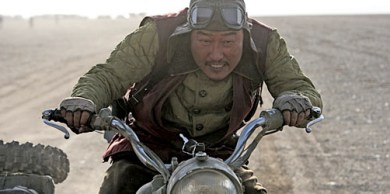
Jee-woon regular Lee Byung-hun is also awesome as “The Bad,” Jung Woo-sung is an effortless badass as “The Good,” and even though I’m partial to Kang-ho, they all more than hold their own and bring three outstanding characters to life who more than live up to the Western icons they’re paying tribute to. In short, it’s ridiculous how many fronts this thing destroys on.
The Good, The Bad, The Weird is one of those rare movies that’s just so effing good it makes me borderline angry. Angry that it took me so long to give it a chance ’cause I thought it would be way weirder than it actually was, angry that so few people have seen it, angry that I have to convince people to look past the subtitles in order to get them to see it, and angry that Americans just don’t make movies like this. Maybe Tarantino, but that’s it. The ending leaves something to be desired, but aside from that, I can’t remember the last time I had so much fun with a movie. I know it might not look like much from the outset, but don’t make the same mistake I did, this one’s too damn good to pass up.
Wild soundtrack, too
And the best Kevin Smith movie is…
 CLERKS!!!
Man, I am seriously in the minority on this one, huh? Think I’ve seen this movie three times now in the hopes that something will click, but alas, I’ve never gotten the draw. Nevertheless, there will always be Dogma and Chasing Amy, and those, dear readers, are out-of-freaking-sight. Itching to check out Red State on Netflix Instant to see how it measures up, but here’s to hoping that those Hit Somebody movies are a fitting swan song to the geekiest film maker out there.
RESULTS:
– Clerks: 14 votes
– Chasing Amy: 9 votes
– Dogma: 7 votes
– Jay and Silent Bob Strike Back: 4 votes (still hilarious)
– Mallrats: 3 votes
– Clerks II: 2 votes (might regret saying this, but I actually thought it was better than the first one)
– Zack and Miri Make a Porno: 2 votes
– Red State: 1 vote
Sucker Punch (2011)
 VERDICT:
3/10 Lollipop Chainsaws
Exactly why 13-year-old boys with anime girlfriends aren’t allowed to make movies.
Sucker Punch is about a girl who gets sent to an insane asylum when her evil stepfather frames her for her sister’s murder. Upon entering the loony bin, she taps into her vivid imagination that transforms the roach motel into a high-class nightclub of sorts where she’s the latest saucy attraction in a lineup of female dancers. In order for her to escape from this hellhole before getting lobotomized into a vegetable, she dives even further into her imagination where she has to battle some seriously crazy shit to obtain the five key items that will set her and her fellow heroines free.
I feel like I need to add an extra sentence to that last paragraph in order for this story to make sense, but alas, explanations are hard to come by with this one.

So if there’s a selling point to this movie, it’s that it’s the brainchild of writer/director Zack Snyder. Now, a lot of people really seem to like Zack Snyder. I thought he did a bang-up job with Dawn of the Dead, I was one of the many young men who went home and started doing push-ups after feeling like the fattest bastard alive thanks to 300, but ever since then, things just haven’t been the same between Zack and I. Maybe it was a bad idea to have anyone adapt Watchmen into a movie in the first place, but the night I saw that movie in a packed theater in Harlem filled with way more kids and their crappy parents than I can still fathom was the very night I realized everything I don’t like about Zack Snyder movies:
Slow-motion overkill and a glorification of men beating the everloving tar out of women. Pretty sure the latter wasn’t an issue in The Owls of Ga’Hoole, but those were the two reasons I still don’t like Watchmen and those are two reasons I didn’t like Sucker Punch.
The good thing is that the slow-mo isn’t as much of a hindrance here because it doesn’t get in the way of the story like it did in Watchmen. The action is noticeably better when it’s operating in real-time, but at this point, slow-mo just comes with the territory when you go into a Zack Snyder movie and it works for what it is. So I guess the real issue here is that there isn’t even a story for the slow-mo to dumb down.
The problem with the story is that it takes itself way too seriously and doesn’t make a lick of sense when it absolutely needs to. Not sure why Snyder went for that tone after writing the imaginary dragon-slaying scene, but the glove don’t fit. And while the list is long, the most criminal of the the said nonsensical aspects is without a doubt the way the characters go from dancing on a stage in one reality to fighting in a warzone the next. It’s never really explained how or why they get transported into a video game fantasy every time they start grooving to the music, and as much as we’re probably supposed to just go with the flow on this one, I was a hell of a lot more confused than I was wowed. This is a running theme.

And then there’s the whole misogyny thing that’s only gotten worse since Carla Gugino got her face beat into hamburger in Watchmen. Now, I’m all for tough women in movies and I can understand a gal getting roughed up in the heat of battle or something along the lines of Sarah Conner getting stabbed in the shoulder by the T-1000. That happens, I can let that slide, but then girls start getting shot in the brain execution style like something out of The Pianist, and we’ve got ourselves a problem. Again, I don’t see what that adds to the movie or why Snyder thought that’d be a fine addition to the script, but it’s awfully warped and I have no freaking clue how this got away with a PG-13 rating.
On top of all this, there’s the soundtrack, and I honestly don’t know how you fuck up a soundtrack this badly without having every song be an autotuned version of “Walking on Sunshine.” The kicker is that every one of these songs had the potential to be winners. “Sweet Dreams (Are Made of This),” “White Rabbit,” “Search and Destroy,” “Where is My Mind?,” and “Asleep” are all damn good tunes on their own right (except for the Eurythmics, never really liked them). But rather than leave them be and use them in their already awesome states, the powers that be decided that all these classics were in dire need of covers because, let’s face it, even the most classic of ballads can never be “too emo.” It wouldn’t be that bad if the originals weren’t so good to begin with, but now with this fresh coat of synth and moaning thrown into the mix, the songs blow and the soundtrack is an embarrassment to the artists it tries to “honor.” Unless you’re all about listening to bastardized versions of “We Will Rock You” and “Tomorrow Never Knows” while a girl named “Babydoll” butchers members of the steampunk Nazi party, I think you’ll agree. Freddie Mercury and John Lennon would not approve.
The only saving grace to the playlist is a relatively untouched version of Bjork’s “Army of Me” which actually works damn well, but that’s very much the exception to the rule.

Ultimately, I just found myself asking “What’s the point?” far more often than is healthy for a two-hour investment. What’s the point of shooting those girls in the head? What’s the point of turning the “dances” into bullet ballets? What’s the point in general and why should I be giving a shit? That last one’s a biggie and it unfortunately never got answered. I’ve found myself asking a lot of questions like that in Zack Snyder movies lately, and unless I’m missing the point, I don’t think that’s a good thing.
Sucker Punch isn’t as bad as I was expecting it to be, it has style to spare, and some of the action scenes are surprisingly boss when Snyder cools it on the slow-mo. But like I said, it’s an exercise in the excessive, the unnecessary, and its “fight for your destiny” moral ends up falling on deaf ears when it’s set against the backdrop of scantily-clad leather mamas fighting minigun-toting mega samurai. The thing is, I know there’s an audience for this movie and I can totally understand how a young geek who just discovered The Matrix and porn could watch this ad nauseum and feel like Zack Snyder made a movie just for them. It’s not that that’s a bad thing, it’s just not my thing and I can’t help but wonder about a writer/director who goes out of their way to make it their thing. The ridiculous dialogue that tries way too hard to be badass, the story that didn’t stand a chance, and the cast that was doomed from the start – it just doesn’t work.
Stupid title, too.
Bill Cunningham New York (2011)
 VERDICT:
10/10 Rose-Colored Lenses
A wonderful movie about a wonderful man.
Bill Cunningham New York is a documentary about a guy named Bill Cunningham. For some 50-odd years now, Bill has made a career for himself by hitting the streets of New York City each day and taking pictures of everyone who catches his eye. At the end of each week, he takes his favorite photographs of his favorite clothes in action and puts them all together in a weekly photo column for The New York Times. Over the years, he has become the face of street photography in the fashion world and captured every trending style on camera before everyone else even realized a trend was there. He also happens to be a model human being who’s loved by anybody he’s ever met, and that sure doesn’t hurt matters.
Now, this is the kind of movie that makes me glad I have a blog, that makes me pat myself on the back for keeping an open mind and being gung-ho about watching whatever comes my way. Before I watched this, I’d never even heard of Bill Cunningham and never so much as glanced at the Fashion section of The New York Times. If my wardrobe comprised of graphic tees and my favorite pair of ripped jeans that I refuse to throw out despite the fact that grunge is never coming back is any indication, fashion just isn’t my thing and so I assumed that a doc about Bill Cunningham wasn’t exactly my fit. But the funny thing is that this movie isn’t really about fashion and Bill Cunningham is my new personal hero. Like I said, pays to open-minded.

See, Bill Cunningham isn’t so much a fashionista as he is a lover of clothes and a lover of life. He’s just a man with a bike, a camera, and a trademark poncho who gets to take pictures of his favorite things for a living. If that isn’t a dream job, I don’t know what is. Take for instance a scene where he shows up to Paris Fashion Week and can’t get inside because one of the young female staffers doesn’t know who he is. Five seconds later, a veteran staffer comes along and informs the girl, “Please, this is the most important man in the world,” before escorting Bill inside who doesn’t seem upset in the slightest. If you didn’t know who he was, you’d never guess he was a fashion icon, but that’s what’s great about Bill and what’s even better is that he doesn’t even feel that he deserves it.
No, his life isn’t “glamorous,” he doesn’t place any real value in money, he works all day and sleeps on wooden cot at night, he’s never been in a romantic relationship of any sort, and he’s gotten his bike stolen 28 times. For chrissakes, the guy’s worn one outfit in public for decades upon decades, and it’s a blue poncho worn by Parisian sanitation workers that he rarely replaces because duct tape is cheaper. Having never met the guy, one could understandably write him off as a mole person who got evicted from his shack under the F train, but then you do meet him and instantly realize that he’s a front-runner for the happiest person alive.

And that’s the thing about Bill, in many ways he’s the personification of all those lessons you learned growing up about how money doesn’t buy happiness and that you can’t take it with you, the lessons that slowly started to fade when college and you entered the dreaded “real world.” He loves clothes – the more extravagant the better – but he’d rather look on than buy into the ridiculous frivolity and social status that those who have it hold so dear. In a society that’s so obsessed with celebrity, paparazzi, and judging others for how they’re “different” rather than celebrating them for their individuality that makes our world a far less boring place to live in, Bill Cunningham is the voice of reason. I doubt that was ever his goal and I doubt he’d ever admit to a statement like that, but it’s true from top to bottom. In the immortal words of Lester Burnham, “This isn’t life, this is just stuff, and it’s become more important to you than living. And, honey, that’s just nuts.” Bill would never be so brash as that, but you get the idea.
My love for this movie is far more about the subject than it is about the film making, but since my chance introduction to Bill Cunningham ended up changing my life, it’s a moot point to say that its technical merits don’t quite measure up to its star. Although for what it’s worth, director Richard Press does a swell job of putting everything together and he does an outstanding job of giving us a truly genuine look at the man behind the poncho without having to invade his privacy. I’m sure Press’ intent in making this movie was just to share Bill Cunningham with the world at large, but the end result ended up being so much more than that even if Bill was never even trying for it.

The difference between a documentary like this and that of Food, Inc., The Cove, or Inside Job is that, while those all enlighten us to the somber realities of the world we live in, Bill Cunningham New York acts a call to embrace the realities and joys of an ever-changing world. Not that there’s anything wrong with those other documentaries, but after nearly being brought to tears of joy by the time it was over, the 84 minutes I spent with Bill Cunningham are going to stick with me for far longer than anything else I’ve seen in ages.
It’s just so special and elevating to discover a film that affects you so deeply that it literally changes the way you look at the world. Before seeing this movie, it wasn’t unusual for me to walk by some of the more uniquely garbed individuals in New York City and wonder why anyone in their right mind would choose to dress like a hipster. Now, I feel like an ass for ever thinking that. Bill had it right all along while I just sat there drinking the Kool-Aid. For shame.
One of my all-time favorite quotes to live by is from Conan O’Brien during his farewell address on The Tonight Show when he said, “If you work really hard and you’re kind, amazing things will happen.” Well that’s Bill Cunningham, that’s why the world deserves to meet him, and that’s why I gave this my first 10 of the year. He’s a vision of kindness, happiness, and eternal youth that many lose long before they reach 80, and we could all learn from his example.
And the best Nic Cage movie is…
 RAISING ARIZONA!!!
Well okay then! Barely beat out Face/Off (which I still haven’t seen), but if there were ever a role that didn’t make me hate Nic Cage, it’s that of good ol’ H.I. McDunnough.
Never been much of a fan, but everyone’s got their moments. Swell voting, folks!
RESULTS:
– Raising Arizona: 12 votes
– Face/Off: 11 votes
– Adaptation: 9 votes
– The Rock: 7 votes
– Kick-Ass: 7 votes
– Leaving Las Vegas: 3 votes
– Con Air: 1 vote
– Fast Times at Ridgemont High: 1 vote
– Other: 1 vote for Wild at Heart (never seen it, heard good things), 1 vote for 8MM (creepy, yo), 2 votes for National Treasure (fun stuff), 1 vote for Birdy (really need to see that again), 1 vote for Moonstruck (word), 1 vote for Bad Lieutenant: Port of Call New Orleans (need to check that out, need to see the first one though), 1 vote for Matchstick Men (heard good things), 1 vote for Gone in 60 Seconds (all I remember is Angelina’s dreadlocks), 1 vote for Lord of War (never seen it, awesome poster though).
And sorry for the lack of reviews around these parts. Days have been mighty strange as of late and been using most of that time to work on the old screenplay. Will get things going again soon though, seen some mighty good movies as of late, and they’ll get the treatment in due time. So many movies, so little time.






 Cut The Crap Movie Reviews